

In this entry
- Why Welsh road signs are bilingual, and why Welsh comes first
- Welsh road signs translated: the words you will actually meet
- 20 mph signs in Wales
- Traffic Wales and the variable message signs
- Place-name signs: Eryri, Bannau Brycheiniog and Yr Wyddfa
- Brown tourist signs in Wales
- Practical tips for reading Welsh road signs at speed
- Quick answers
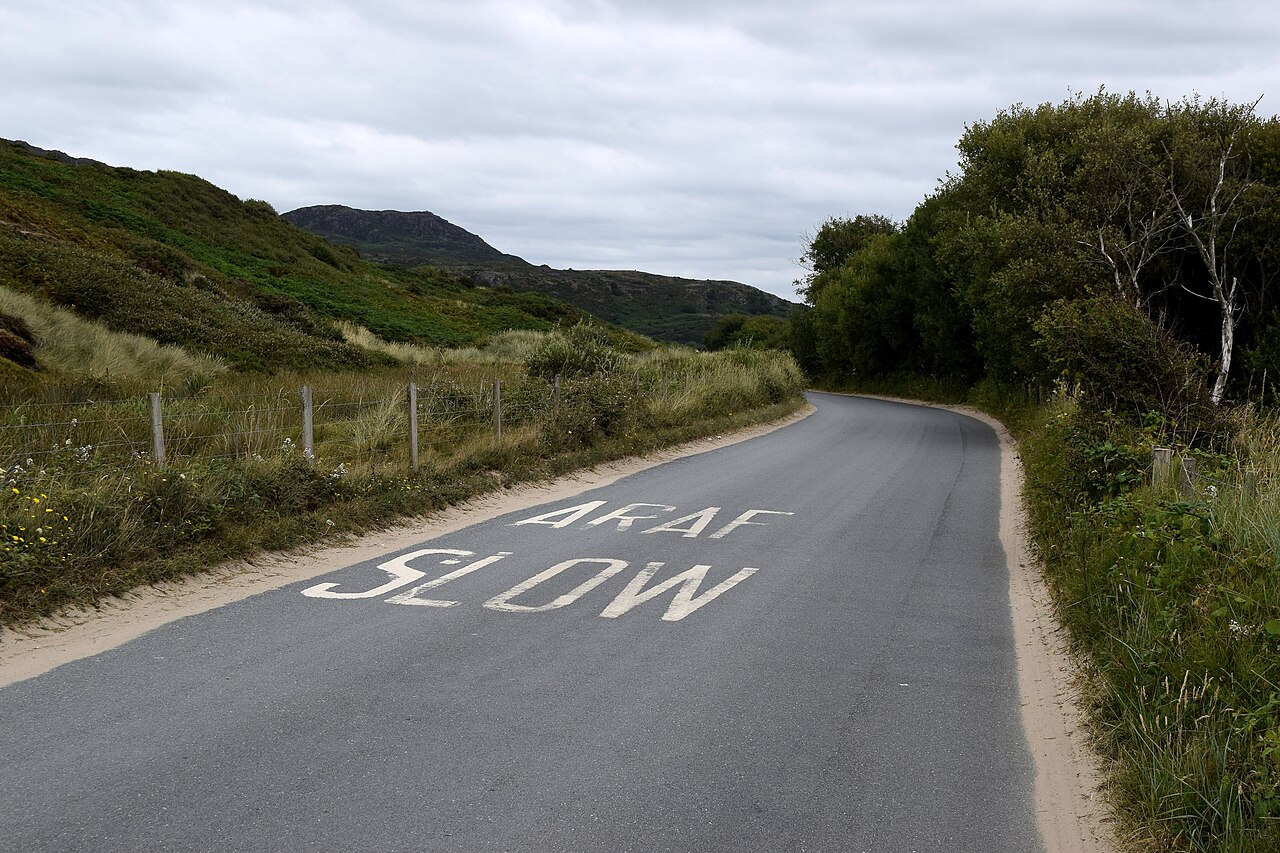
Road signs in Wales are bilingual, and on every new or replaced sign the Welsh comes first: above the English, or occasionally to its left. The meaning never changes between the two lines, so a visiting driver only ever needs to read the English half. The one word worth learning before you arrive is ARAF, painted across the tarmac on approach to bends and villages. It means slow.
01Why Welsh road signs are bilingual, and why Welsh comes first
Welsh has official status in Wales, and public bodies, including the Welsh Ministers and every local highway authority, work under the Welsh Language Standards. Standard 61 says that any text on a new or renewed sign, temporary signs included, must be displayed in Welsh. Standard 62 adds that where a sign carries the same information in both languages, “the Welsh-language text must be positioned so that it is likely to be read first”. Before these rules councils chose the order themselves, which is why you will still pass older English-first signs that have not yet reached the end of their life.
The detail sits in the Department for Transport’s Traffic Signs Manual, Chapter 7, Section 16. It confirms that all new and replacement signs place Welsh above (or occasionally to the left of) the English, and it carries one rule drivers will appreciate: lettering size is set by the speed of approaching traffic and “should not be reduced to accommodate both languages”. A bilingual sign is bigger, not harder to read.
Legally, the signs themselves still come from the UK framework. The Traffic Signs Regulations and General Directions 2016 (TSRGD) prescribe the shapes, colours and symbols used across Great Britain and preserve the Welsh Ministers’ power to authorise signs. A small set of bilingual plates is prescribed by the Traffic Signs (Welsh and English Language Provisions) Regulations and General Directions 1985; the Manual notes that every other bilingual sign, including all direction signs and road markings, must be authorised by the Welsh Government.
02Welsh road signs translated: the words you will actually meet
The Welsh Government publishes a list of standard bilingual traffic signs that highway authorities may put up without further authorisation. Every pairing below is taken from that list, so these are the exact words on the posts and painted on the road, not phrasebook Welsh.
| Welsh | English | Where you’ll see it |
|---|---|---|
| ARAF | Slow | Painted across the lane before bends, junctions and village entries |
| ARAFWCH NAWR | Reduce speed now | Plate beneath a warning triangle ahead of a hazard |
| ILDIWCH | Give way | Junction plates and road markings |
| DIM MYNEDIAD | No entry | Under the red no-entry roundel |
| DIM FFORDD ALLAN | No exit | Entrances to cul-de-sacs and car parks |
| UNFFORDD | One way | Town streets |
| YMLAEN YN UNIG | Ahead only | Junction plates |
| CANOL Y DREF | Town centre | Direction signs and road markings on approach to a town |
| Gwasanaethau | Services | Motorway and trunk road services, e.g. Gwasanaethau Magwyr (Magor services) |
| Maes parcio | Car park | Car park signs in towns, villages and at viewpoints |
| FFORDD AR GAU | Road closed | Road works and incident signs |
| Gwyriad | Diversion | Yellow diversion route signs |
| Ciwiau’n debygol | Queues likely | Temporary signs ahead of works |
| Damwain | Accident | Temporary and police incident signs |
| HEDDLU | Police | Police incident signs and vehicles |
| Cerddwyr | Pedestrians | Warning plates and road works signs |
| Ysgol | School | Plates beneath the children warning triangle |
| YSGOL CADWCH YN GLIR | School keep clear | Yellow zigzag markings outside schools |
| Arhoswch | Wait | Pedestrian crossings, as in Arhoswch am yr arwydd (wait for the signal) |
| Anaddas i gerbydau nwyddau trwm | Unsuitable for heavy goods vehicles | Approaches to narrow lanes and mountain roads |
| Ffyrdd eraill | Other routes | Direction signs at junctions |
| Diwedd | End | End of a restriction, diversion or works |
| Cyflymder uchaf | Max speed | Temporary speed limit plates at road works |
| Gyrrwch yn ofalus | Please drive carefully | Leaving towns and villages |
| Croeso i Gymru | Welcome to Wales | Border crossings from England |
| Twnnel | Tunnel | e.g. Twnnel Conwy (Conwy Tunnel) on the A55 |
Two patterns help. Words ending in -wch (arafwch, ildiwch, arhoswch, gyrrwch) are instructions addressed to you. And because Welsh mutates the start of words, the same word can look different in context: Cymru becomes Gymru after “i” in Croeso i Gymru. Neither should trouble you at the wheel, because the English is always right there.
0320 mph signs in Wales
Since September 2023 the default limit on restricted roads in Wales, typically streets with street lights in built-up areas, has been 20 mph rather than 30 mph. Because 20 mph is now the default, the Welsh Government notes there are no repeater signs on those roads: once you pass a 20 sign entering a village, assume 20 until a sign tells you otherwise. In July 2024 it issued revised guidance allowing highway authorities to return selected roads to 30 mph, each change needing a traffic regulation order, so some routes you knew at 20 may now be signed 30. Our guide to 20 mph in Wales covers how the limits work in practice.
The bilingual plate you may see at temporary limits through road works is Cyflymder uchaf: max speed. The number in the roundel is the same in both languages.
04Traffic Wales and the variable message signs
On the motorway and trunk road network, the electronic overhead and roadside boards are run by the Welsh Government’s Traffic Wales service with its two trunk road agents. These boards have few characters to play with, so the Welsh Government explains in an April 2026 freedom of information response that it is “sometimes necessary” to show a message in Welsh, closely followed by the same message in English on the next sign. Where signs are sparse between junctions, you may only see the Welsh version.
That is where the glossary earns its place. FFORDD AR GAU (road closed), DAMWAIN (accident) and CIWIAU (queues) are the words most likely to appear on their own. Traffic Wales has also been replacing life-expired message signs, mostly on the M4 in South East Wales, with LED units, and the Welsh Government says the new boards will make it easier to set messages in both languages. For the live picture before a long run, Traffic Wales publishes incidents, roadworks and cameras for the trunk network.
05Place-name signs: Eryri, Bannau Brycheiniog and Yr Wyddfa
Many towns share one spelling in both languages, so you will often see a single name where you might expect two; Llandudno is simply Llandudno. Others differ completely: Abertawe is Swansea, Aberhonddu is Brecon, Magwyr is Magor. The Welsh name sits on top.
The national parks now lead with their Welsh names too. Snowdonia National Park Authority voted to use Eryri and Yr Wyddfa (for Snowdon) in both Welsh and English, and the Brecon Beacons National Park became Bannau Brycheiniog in April 2023, roughly “the peaks of Brychan’s kingdom”. Expect those names on brown signs and in park literature. Our Eryri drives and Bannau Brycheiniog drives use them throughout.
06Brown tourist signs in Wales
Brown signs point to attractions, viewpoints and car parks, and they are bilingual like everything else. The TSRGD includes symbols specific to Wales, among them one for a tourist destination recognised by the national promoter of tourism for Wales and one for properties in the care of the Welsh Ministers, which today means Cadw’s castles and abbeys.
07Practical tips for reading Welsh road signs at speed
- Read one line, not two. Pick out the English line and ignore the Welsh above it. On direction signs the two names of each place sit together as a pair, with a wider gap before the next destination.
- Road numbers are universal. The A470, A4069 and B4391 read the same in either language, so navigate by number and the bilingual destinations stop mattering.
- Treat ARAF as a promise. Painted ARAF before a bend usually means the bend is tighter than it looks, especially on single-track roads.
- Know the closure words in winter. FFORDD AR GAU and Gwyriad matter most on high routes; our notes on Welsh mountain passes in winter explain which roads close first.
- Heed the HGV warnings. Anaddas i gerbydau nwyddau trwm on a lane is a strong hint that it is narrow, steep or both; with a large car or a trailer, take it as advice.
For everything else, from fuel to parking etiquette, our guide to driving in Wales covers the rest, and the best driving roads in Wales is where those signs lead.
08Quick answers
- What does ARAF mean on Welsh roads?
- ARAF is the Welsh word for slow. It is painted on the road surface, usually alongside SLOW, ahead of bends, junctions and village entrances.
- Why are road signs in Wales in Welsh and English?
- Public bodies in Wales, including highway authorities, must follow the Welsh Language Standards, which require any text on a new or renewed sign to appear in Welsh and not be treated less favourably than English.
- Which language comes first on Welsh road signs?
- Welsh. On new and replacement signs the Welsh text is placed above, or occasionally to the left of, the English. Some older English-first signs remain until they are replaced.
- Do I need to speak Welsh to drive in Wales?
- No. Fixed signs carry the same message in English, road numbers are identical in both languages and symbols are the standard British ones. Only some electronic message signs may briefly show Welsh before the English follows.
- What does Ildiwch mean?
- Ildiwch means give way. You will see it on plates at junctions beneath the give way triangle, paired with the English GIVE WAY.
Reviewed by Drive Tour Wales in November 2026. Conditions, limits and opening times change, so check before you travel.